MEDIAART 2DF3

Composition Techniques I – Part 1

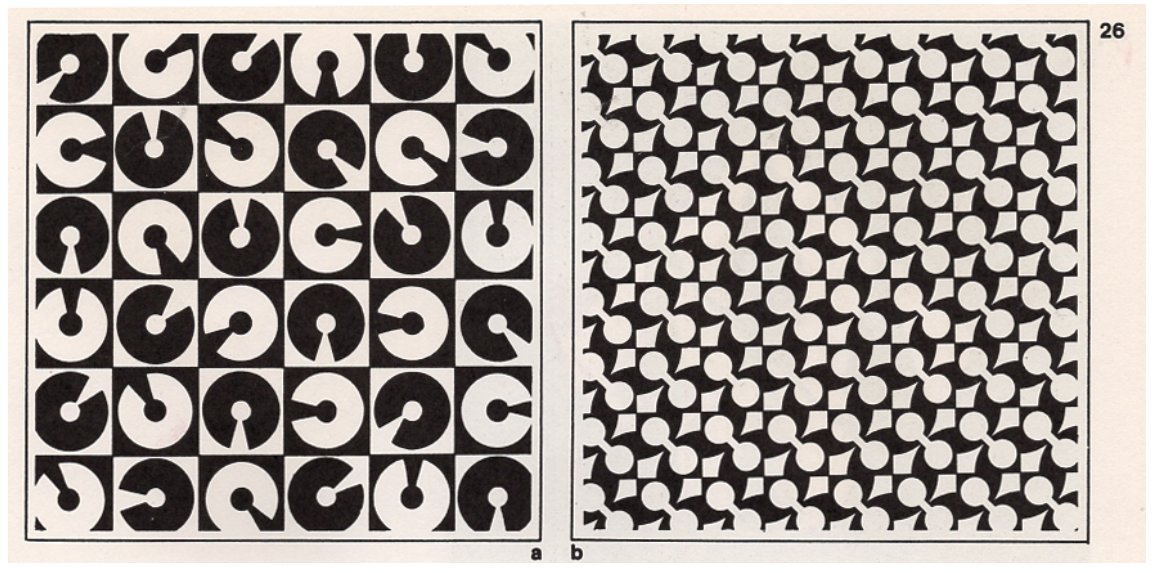
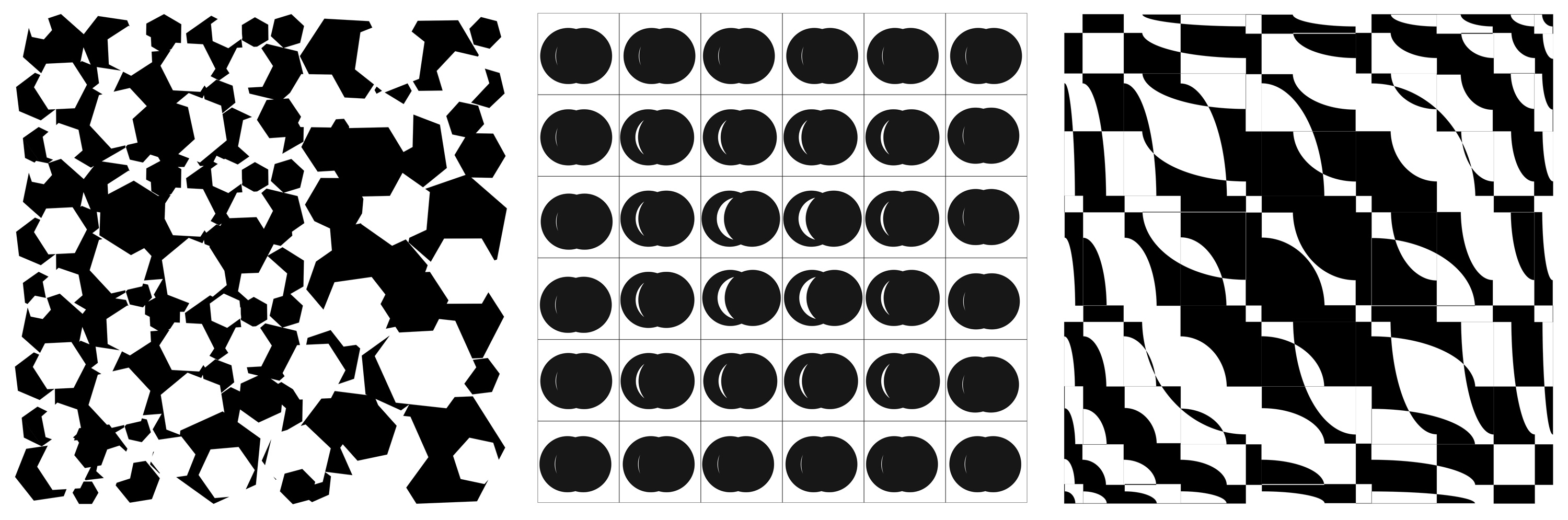
Examples from previous Composition Techniques I activities

Goal

Design and create three black-and-white vector compositions by building, repeating, and systematically altering a super-unit.

Each composition must combine:

Activity overview

Accessibility and learning support

Complete the activity in four stages

Complete the following stages in order.

Stage 1: Review the concepts Review the interrelationships of form, super-units, grids, and spatial strategies before planning.

Principles of Two-Dimensional Design

Interrelationships of Form

Detached, Touching, Overlapped, and Interpenetration

Each composition begins with a super-unit that clearly demonstrates one assigned relationship:

  • Detached: The forms remain separate.
  • Touching: The forms meet at an edge or point without overlapping.
  • Overlapped: One form appears in front of another.
  • Interpenetration: Overlapping forms remain visible through each other, producing shared internal areas.
Super-unit versus composition
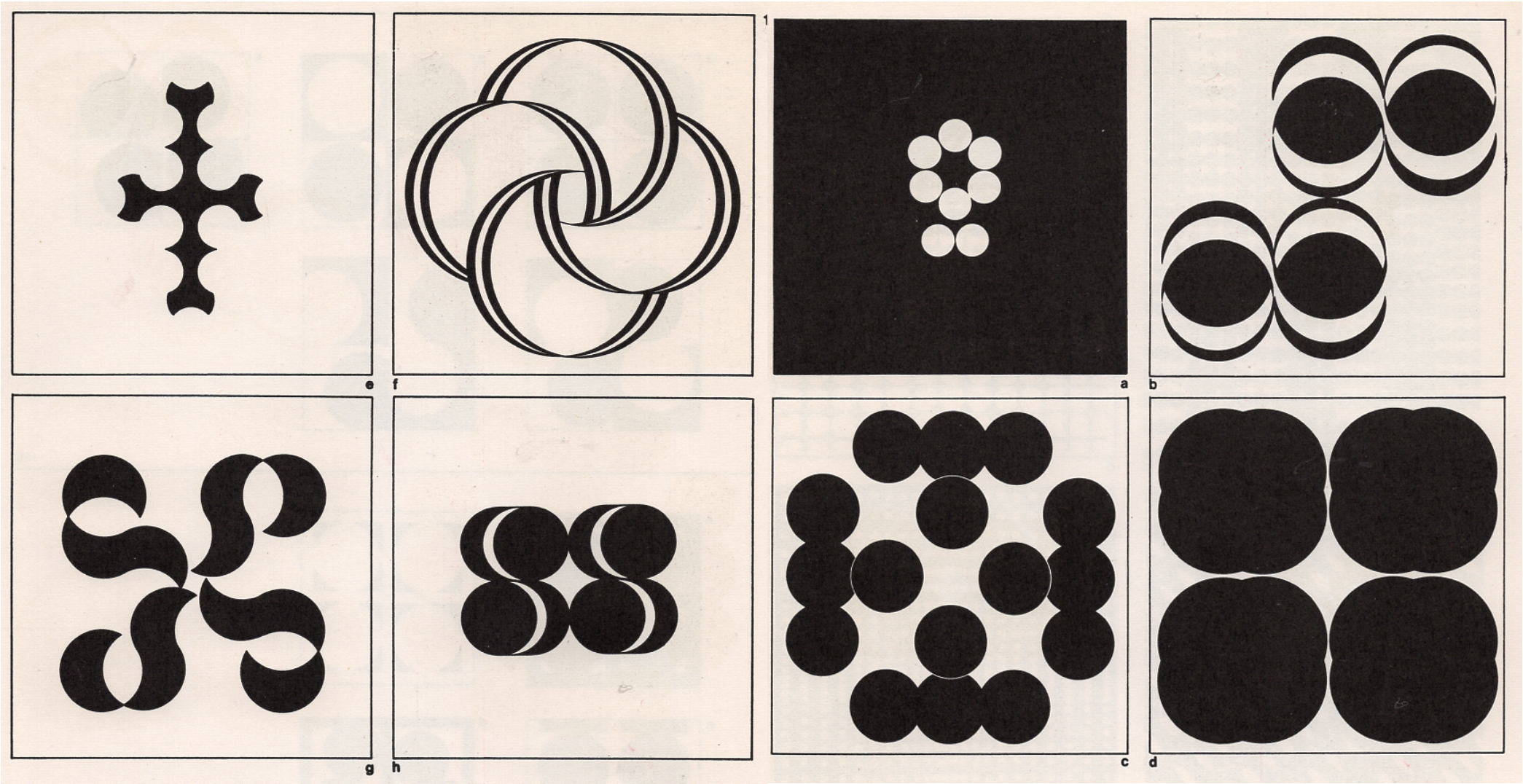
Examples of super-units

A super-unit is a small structure created by combining two or more shapes through an Interrelationship of Form.

The final composition must develop that starting structure into a larger visual system:

  1. Create one clearly resolved super-unit.
  2. Repeat the super-unit at least eight times.
  3. Alter the repeated instances in a controlled way.
  4. Organize the instances through the assigned grid and principle.

The relationship inside the original super-unit must remain identifiable after the instances are altered.

Other Principles
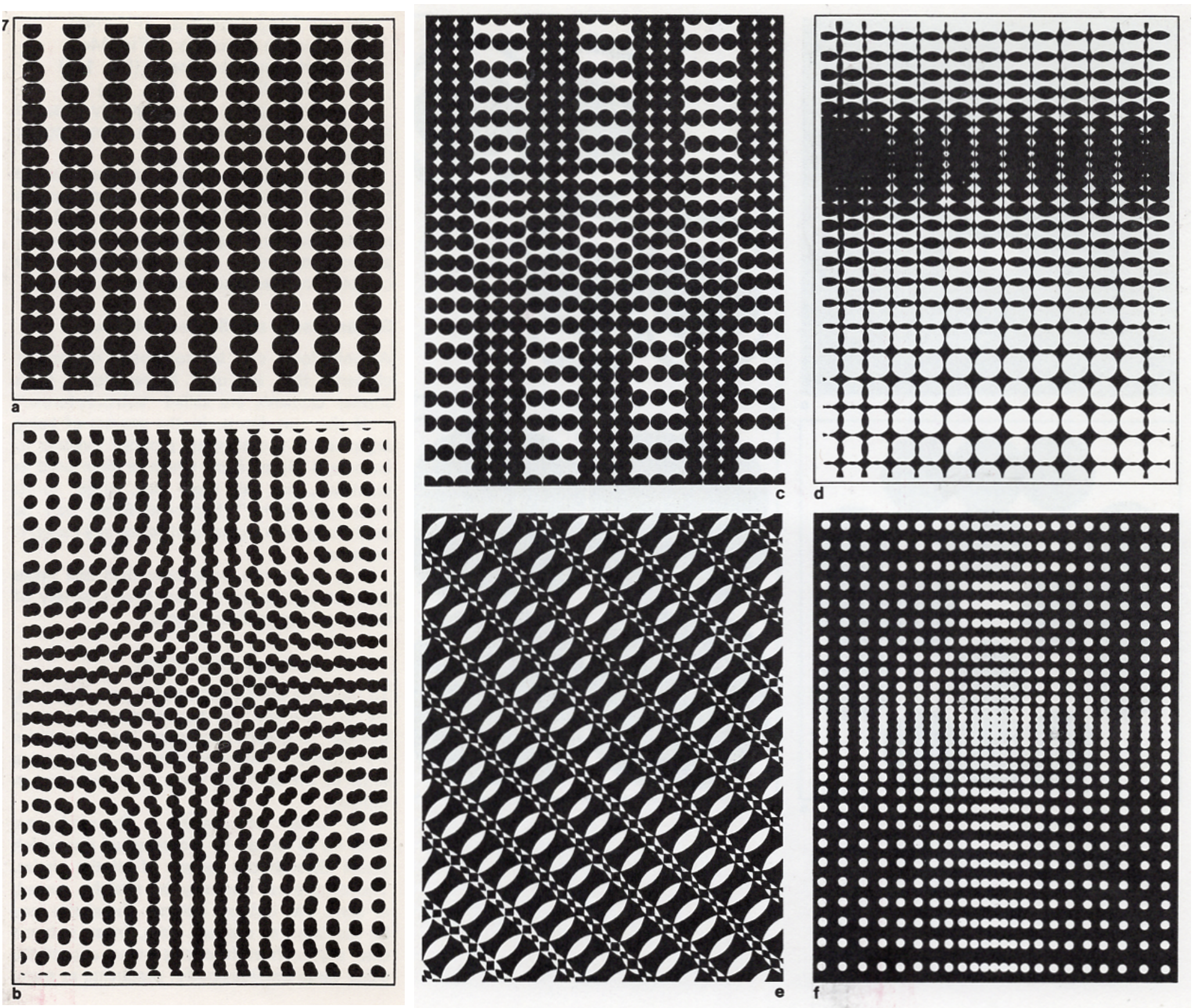
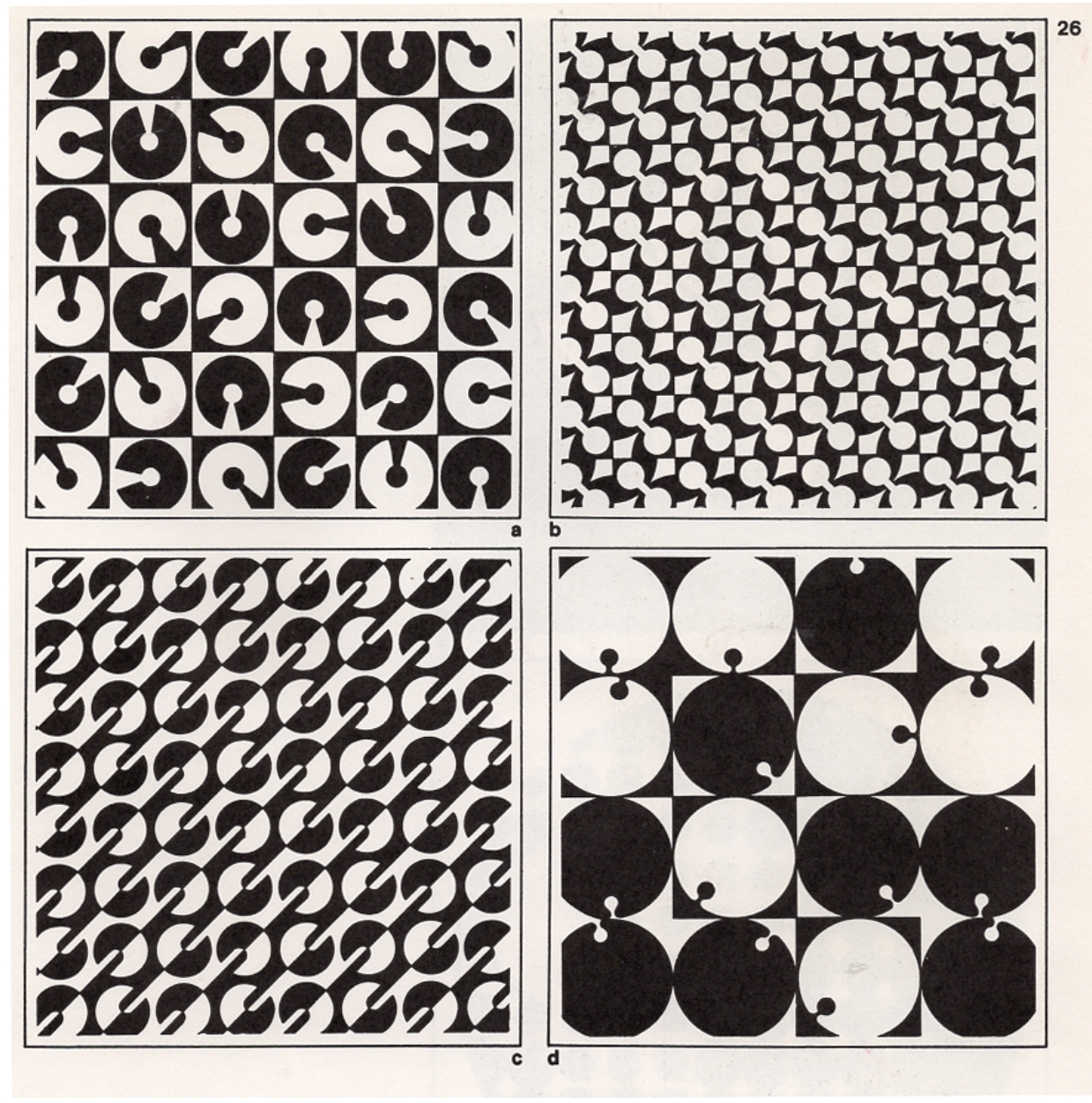
Example showing repeated geometric forms arranged in a regular pattern

Repetition

Repetition occurs when the same visual element is used more than once. Repeated shapes, lines, or forms create consistency, rhythm, and structure across the composition.
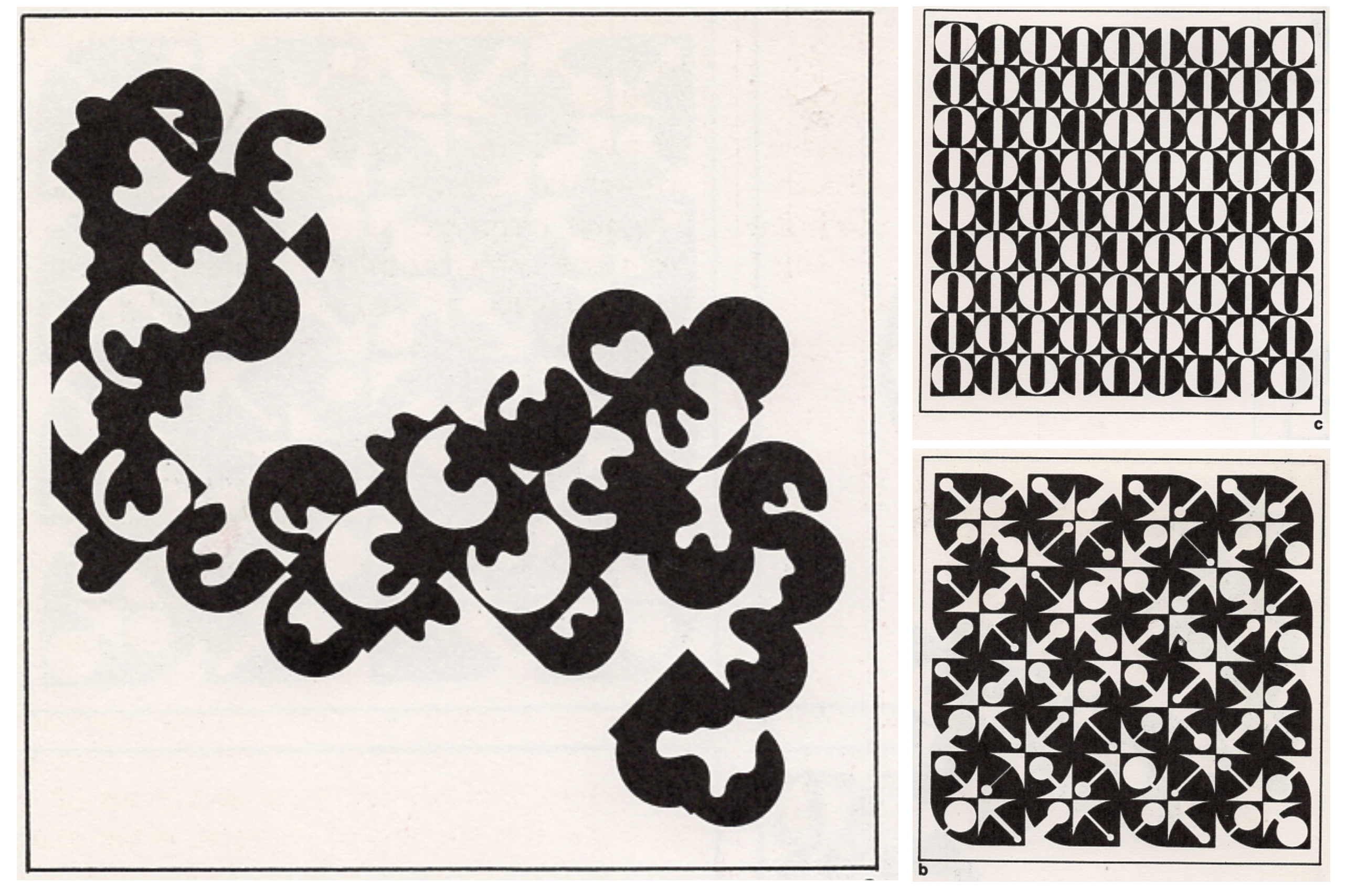
Example showing geometric forms organized through a consistent underlying grid

Structure

Structure is the underlying system that organizes forms within a composition. It controls their placement, alignment, spacing, and relationships through a grid or other consistent framework.
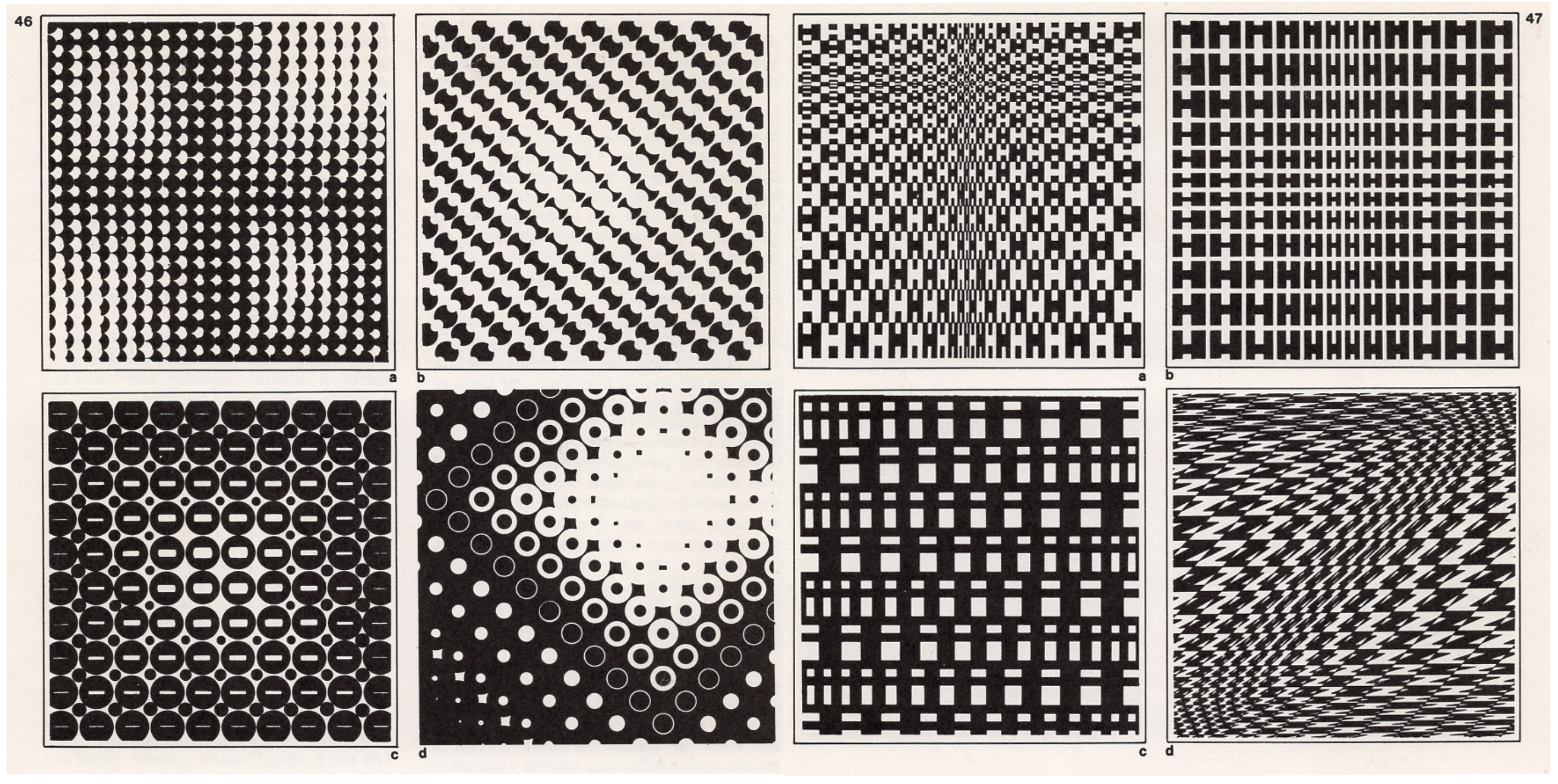
Example showing similar forms repeated with minor variations

Similarity

Similarity occurs when forms share common characteristics, such as shape, size, direction, or texture. These shared features make the elements appear related, even when they are not identical.
Example showing forms changing gradually in size and direction

Gradation

Gradation occurs when visual elements change gradually. These changes may involve size, direction, position, shape, or spacing, creating progression, movement, and visual transition.

Source: Wong, W. (1972). “Principles of Two Deimensional Design”. Van Nostrand Reinhold Company.

Form and Space

The activity also applies three categories of form from Timothy Samara’s chapter “Seeing Form and Space.”
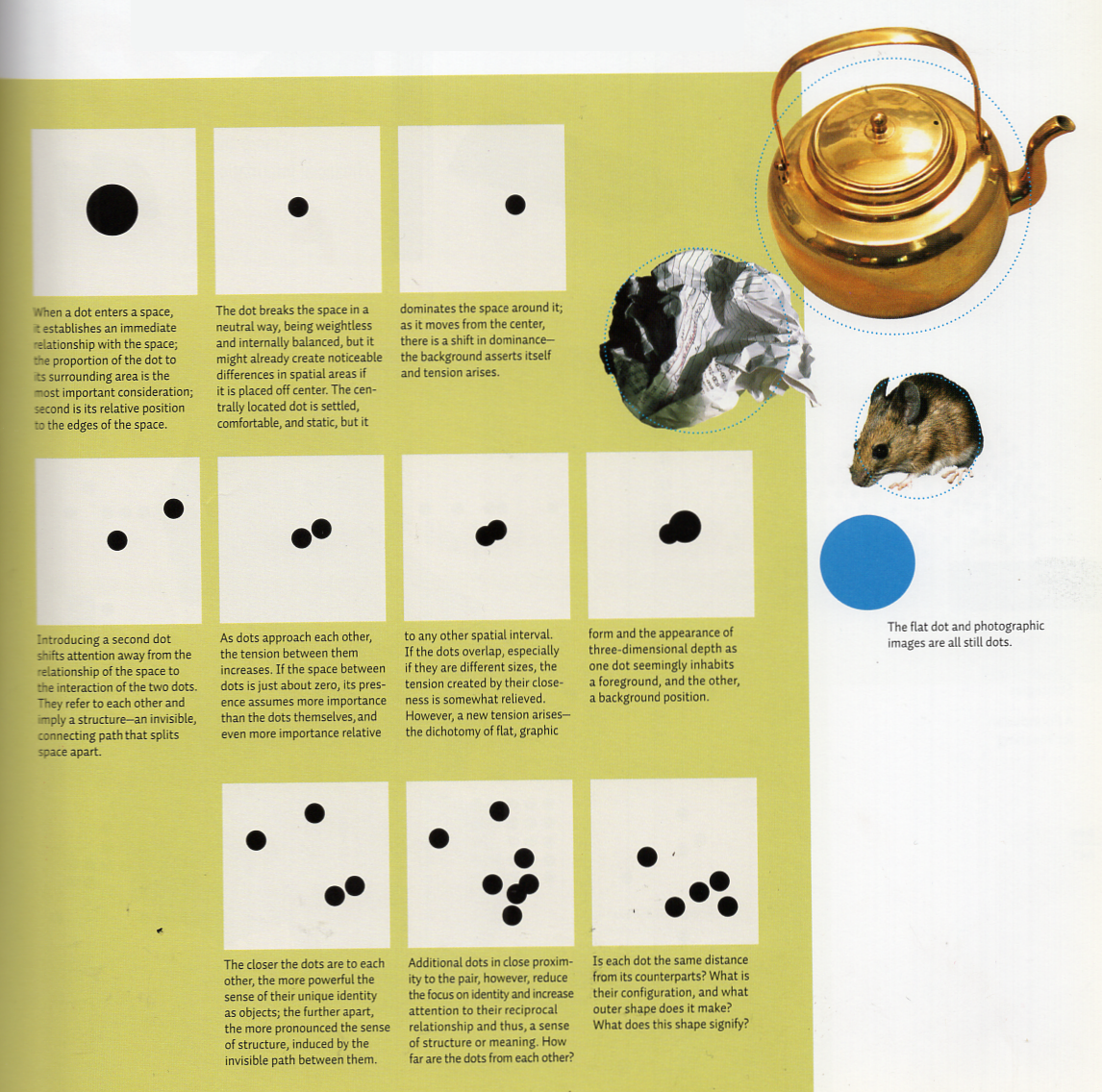
Examples showing how the size, position, spacing, and grouping of dots affect visual attention and spatial relationships

Dot

A dot creates a concentrated point of attention within a space. Its size, position, and proximity to other forms affect its visual dominance, grouping, tension, and relationship to the surrounding format.
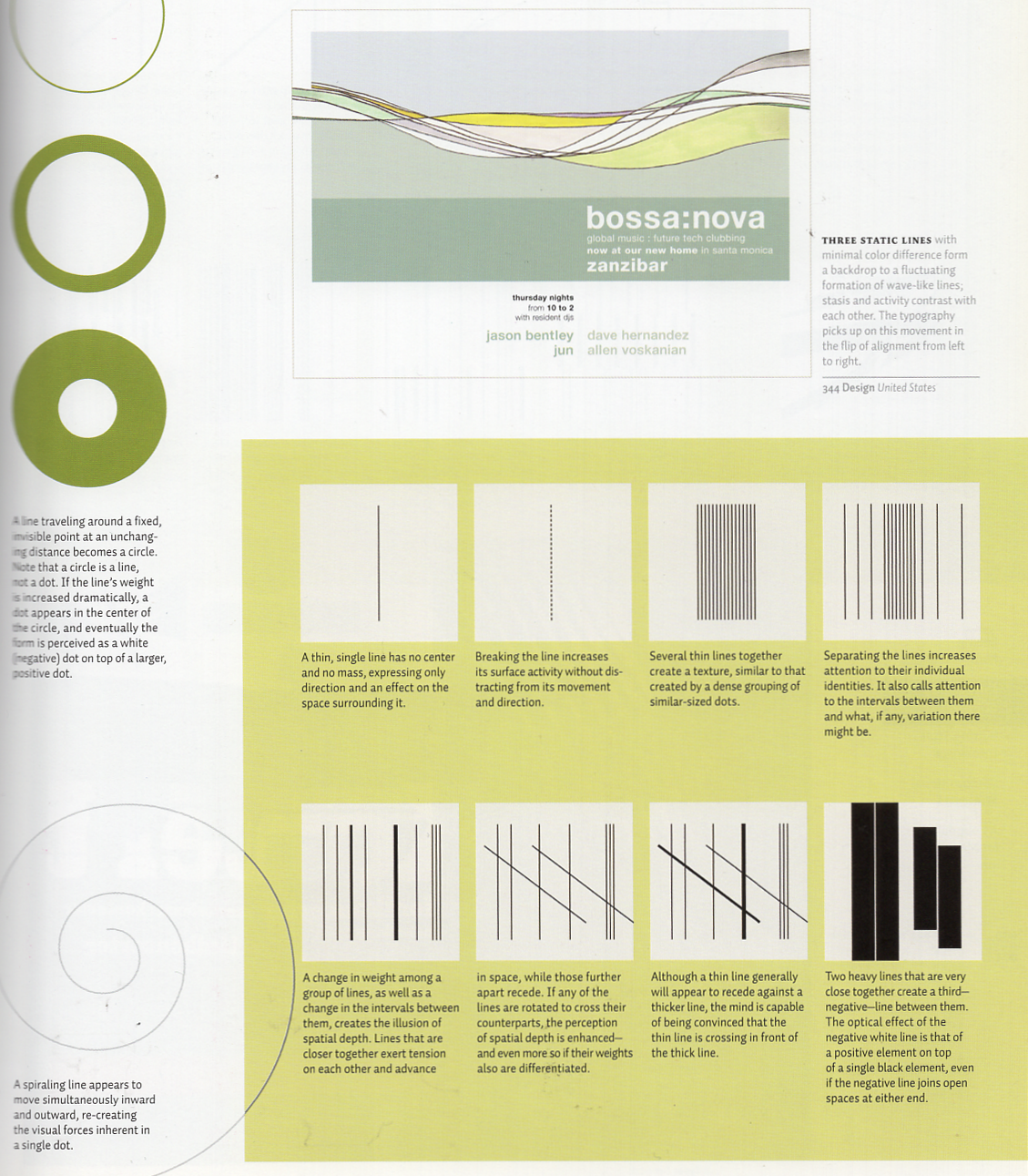
Examples showing lines changing in length, weight, spacing, direction, and sequence

Line

A line creates connection, direction, and movement. It can link points, divide or contain space, and establish rhythm through changes in length, weight, direction, spacing, and repetition.
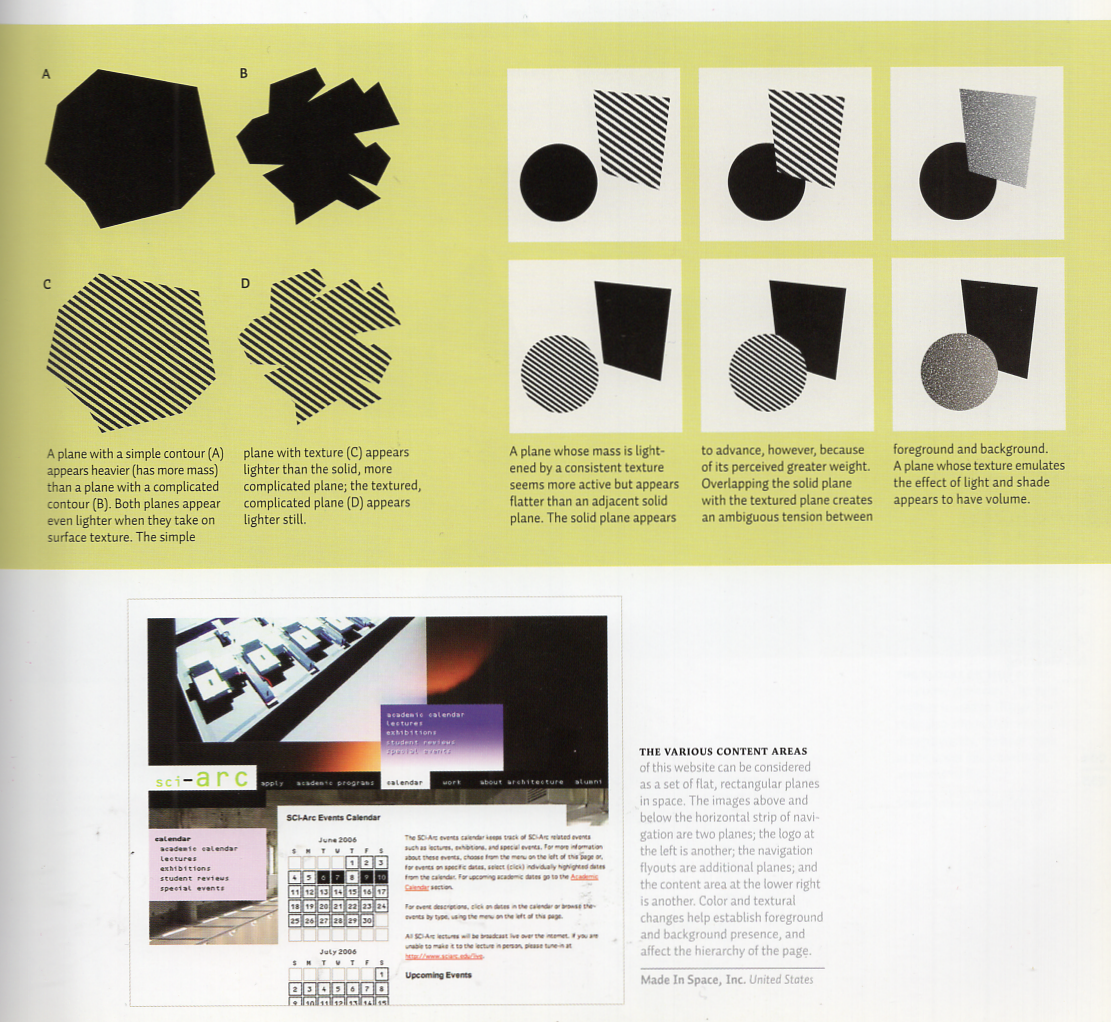
Examples showing planes changing in scale, contour, texture, overlap, and visual mass

Plane & Mass

A plane is a larger form defined by its outer contour. Its scale, shape, texture, value, and relationship to the surrounding space determine whether it appears flat, becomes a dominant visual mass, or creates the impression of depth and volume.

Source: Samara, T. (2007). “Seeing Form and Space: Categories of Form.” In Design Elements: A Graphic Style Manual (pp. 45–53). Rockport Publishers.

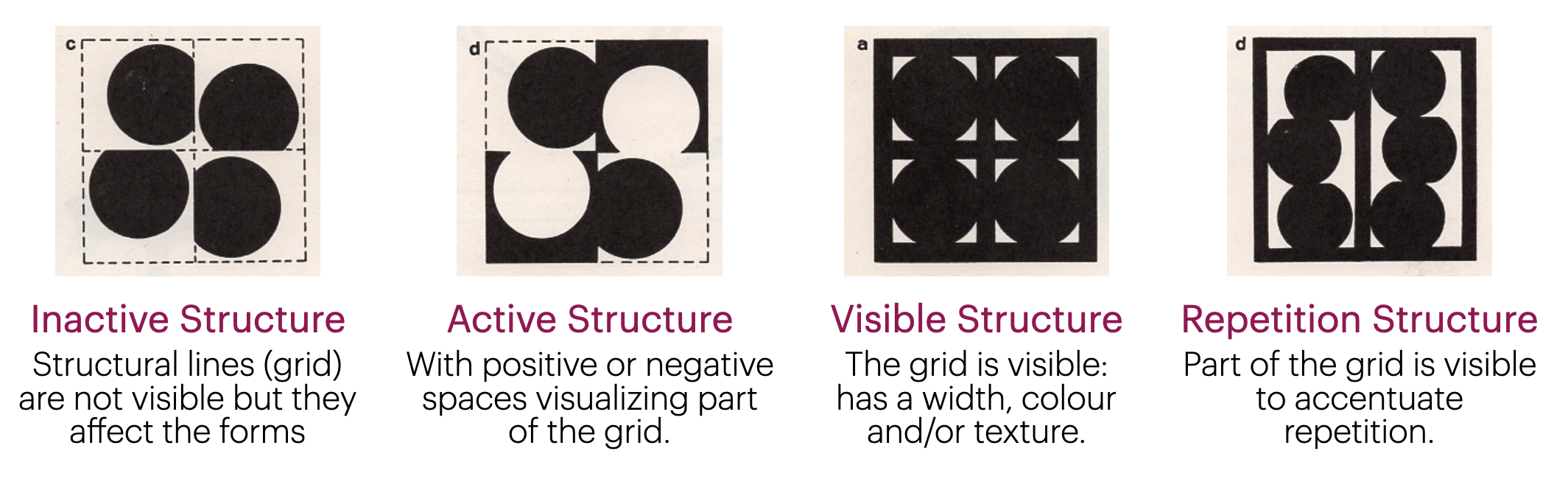
Stage 2: Plan and sketch the three compositions Design each super-unit, select a different repetition grid and grid structure, and plan how the unit will be repeated and altered.

Create one planning page for each composition.

Select the repetition grids and grid structures

Choose one different repetition grid and grid structure for each composition. Do not repeat the selections.

Repetition Grid

Examples of grid structures

Grid Structures

Additional grid examples

Select the grid and structure that best supports:

  • The assigned Interrelationship of Form
  • The assigned Wong principle
  • The assigned Samara form category
  • The organization of the repeated and altered super-units

Composition 1

Interrelationship of Form Wong principle Samara form category
Touching Repetition Dot

Create a super-unit from point-like geometric forms that touch at an edge or point. A point does not need to be a circle; other geometric shapes can also function as points when used as small, concentrated visual elements.

On the planning page:

  1. Draw the super-unit applying the Touching relationship of form.
  2. Label how the forms apply Samara’s concept of Dot.
  3. Sketch at least eight repeated instances organized into the selected repetition grid.
  4. Maintain Repetition while introducing one controlled variation or alteration, such as scale, contour, proportion, placement, overlap, cropping, or positive–negative reversal.
  5. Show the boundaries and negative space by applying the selected grid structure.

Composition 2

Interrelationship of Form Wong principle Samara form category
Overlapped Similarity Plane and Mass

Create a super-unit from planar geometric forms that overlap and establish visible spatial relationships. Consider the visual mass of the planes, and use variations in scale, proportion, contour, or overlap to create different visual weights.

On the planning page:

  1. Draw the super-unit applying the Overlaping relationship of form.
  2. Label how the forms apply Samara’s concept of Plane and Mass.
  3. Sketch at least eight repeated instances organized into the selected repetition grid (different from Composition 1).
  4. Maintain Similarity while introducing one or two controlled variations, such as scale, contour, proportion, placement, overlap, cropping, or positive–negative reversal.
  5. Show the boundaries and negative space by applying the selected grid structure (different from Composition 1).

Composition 3

Interrelationship of Form Wong principle Samara form category
Interpenetration Gradation Line

Create an interpenetrating super-unit that emphasizes linear direction and connection. A line does not need to be straight, vertical, or horizontal; you may vary its direction, break or interrupt it, and change its thickness to create movement and visual variation.

On the planning page:

  1. Draw the super-unit applying the Interpenetration relationship of form.
  2. Label how the forms apply Samara’s concept of Line.
  3. Sketch at least eight repeated instances organized into the selected repetition grid (different from Composition 1 and 2).
  4. Introduce two-three controlled variations or alterations, such as scale, contour, proportion, placement, overlap, cropping, concentration, or positive–negative reversal.
  5. Show the boundaries and negative space by applying the selected grid structure (different from Composition 1 and 2).

Export Sketches

Combine the three planning pages into one PDF:

  • Filename: Lastname-Firstname-CompTech1-Part1-Sketches.pdf

Ask the instructor for feedback before creating the final digital compositions.

Stage 3: Set up and build the three compositions Create the Illustrator files, build each grid and super-unit, then repeat and alter the units across the complete format.

Create one separate Adobe Illustrator file for each composition.

Set up the Illustrator files

Use the following settings:

  • Units: Pixels
  • Size: 1000 × 1000 px
  • Aspect ratio: 1:1
  • Bleed: 10 px on all sides
  • Colour mode: RGB
  • Raster effects: High, 300 PPI

Create and name these layers:

  1. Guides — grid, margins, and construction lines
  2. Composition — super-units and final vector forms
  3. Background — black or white background field

Use these working filenames:

  • Lastname-Firstname-CompTech1-Part1-1.ai
  • Lastname-Firstname-CompTech1-Part1-2.ai
  • Lastname-Firstname-CompTech1-Part1-3.ai
Illustrator document setup

Required tutorial: Follow this tutorial step by step. It includes the required document settings, margin guides, bleed, colour mode, raster-effects resolution, and layer setup. Skipping steps or using different settings may result in lost marks.

Open the “Adobe Illustrator Document Setup” tutorial directly

Basic Illustrator tools

Open the “Basic tools and behaviours in Adobe Illustrator” tutorial directly

Create the grids

Recreate the selected grid for each composition in the Guides layer.

Use a different grid structure for each file. The grid should organize the placement, alignment, spacing, and movement of the repeated super-units.

A grid may remain visible only when its visible structure is an intentional part of the final composition.

Although grids begin as drawn lines, all grids—unless they are intentionally visible—must be converted into guides. This ensures that the grid remains available in Illustrator but does not appear when the document is printed or viewed outside Illustrator.

Open the “Creating grids in Adobe Illustrator” tutorial directly

Note: If you’re using the grid tool for this process, to convert it into guides press Cmd + 5 (Mac) Ctrl +5 (Windows)

Create the original super-units

Use geometric shapes to create the assigned Interrelationship of Form and Samara form category:

  • Composition 1: Touching + Dot
  • Composition 2: Overlapped + Plane and Mass
  • Composition 3: Interpenetration + Line

Place the original super-unit in the Composition layer.

Before repeating it, confirm that:

  • The assigned Interrelationship of Form is clearly visible.
  • The assigned Samara category shapes the construction of the super-unit itself.
  • The super-unit is visually resolved and can support controlled variation.

Open the “Interrelationships of Form in Adobe Illustrator 1” tutorial directly

Develop the complete compositions

For each file:

  1. Repeat the super-unit at least eight times.
  2. Alter the repeated instances through controlled variables.
    • Composition 1: one controlled variable
    • Composition 2: one or two controlled variables
    • Composition 3: two-three controlled variables
  3. Use the selected repetition grid to organize your composition.
  4. Use the assigned Wong principle across the complete composition:
    • Composition 1: Repetition
    • Composition 2: Similarity
    • Composition 3: Gradation
  5. Maintain the defining qualities of Dot, Plane and Mass, or Line as the super-unit is repeated and altered.
  6. Consider the relationship between the composition and the square format, including edges, cropping, margins, placement, and negative space.
  7. Refine the visual balance with your eyes rather than relying only on mathematical alignment.

The repeated instances must operate as a complete composition. A single super-unit, a row of identical copies, or copies placed without a clear visual system will not meet the activity requirements.

Example of a developed composition built from repeated units

Stage 4: Review & Export Part 1 Check the compositions, layers, guides, margins, and editable PDF settings before exporting and submitting Part 1.

Before submitting

Your PDF files will be opened in Adobe Illustrator to review the document setup, layers, guides, margins, and construction of the compositions.

Check the Illustrator document structure

For each composition, confirm that the file contains the required layers:

  1. Guides
    • Contains the selected grid structure
    • Contains the margin guides created during the document setup
    • Contains only guides and construction elements
  2. Composition
    • Contains the original super-unit
    • Contains all repeated and altered instances
    • Contains the final black-and-white vector composition
  3. Background
    • Contains only the black or white background field

Do not leave artwork on the wrong layer or create unnecessary unnamed layers. You may create sub-collections (or groups inside layers) for better organization.

Check the guides and margins

Before saving the PDF:

  • Convert the grid structure into Illustrator guides.
  • Keep the grid and margin guides inside the Guides layer.
  • Confirm that View → Guides → Show Guides is active.
  • Keep the Guides layer visible when saving the file.
  • Confirm that the original margin guides from the document setup remain present.
  • Confirm that the grid and margins align correctly with the artboard.
  • Do not expand, delete, rasterize, or merge the guides with the composition.

Guides should be visible when the PDF is opened in Illustrator, but they will not appear as part of the printed or exported artwork.

Save the editable PDF

Use File → Save As → Adobe PDF.

In the Adobe PDF settings, select:

  • Preserve Illustrator Editing Capabilities

This setting is required so that the layers, guides, editable vector objects, artboard, and document structure remain available when the PDF is reopened in Illustrator.

Final file check

Open each submitted PDF twice:

Final PDF checklist

  • Check the PDF in a PDF viewer. Confirm that the final composition displays correctly and that no guides or construction elements appear in the exported artwork.
  • Check the PDF in Adobe Illustrator. Confirm that the file opens correctly and remains editable.
  • Check the layers. Confirm that the required layers remain separate, correctly named, and contain the correct material.
  • Check the grid. Confirm that the grid has been converted into guides unless it is intentionally part of the visible composition.
  • Check the guides and margins. Confirm that the grid guides and original margin guides remain available and visible in Illustrator.
  • Check editability. Confirm that all required vector objects remain editable and have not been flattened or rasterized.
  • Check the document settings. Confirm that the artboard size and bleed remain correct.
  • Check the filename. Confirm that the filename follows the required naming structure exactly.

Submission files

Item Required filename
Sketches PDF Lastname-Firstname-CompTech1-Part1-Sketches.pdf
Composition 1 PDF Lastname-Firstname-CompTech1-Part1-1.pdf
Composition 2 PDF Lastname-Firstname-CompTech1-Part1-2.pdf
Composition 3 PDF Lastname-Firstname-CompTech1-Part1-3.pdf

Files that cannot be opened, identified, or accessed may need to be resubmitted and may be considered late. Missing layers or margins, unconverted grids, flattened or non-editable files, incomplete repetition, or compositions based on only one isolated super-unit will affect the grade.


Credits: Jessica A. Rodríguez